
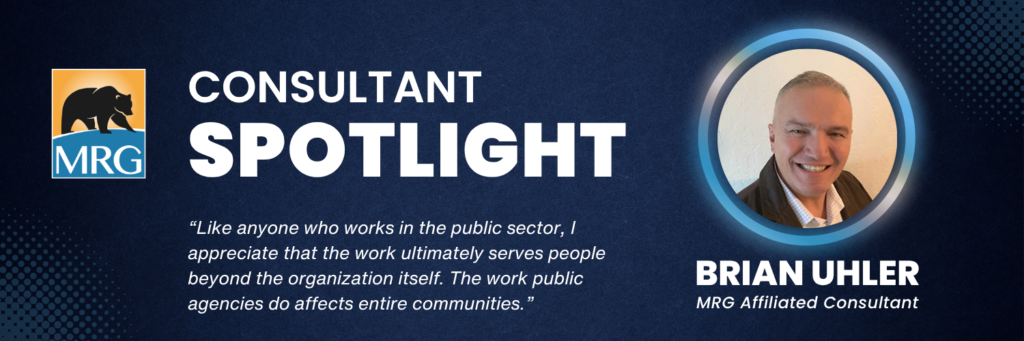
Brian Uhler is a mediator and MRG affiliated consultant with extensive experience in public safety, including over 10 years as a Police Chief and over two years as a Fire Chief. Brian holds a CA POST Executive Certificate, is an FBI National Academy graduate, and holds a Master’s in Public Administration from Texas A&M. As a member of the Bar Association, Brian completed CA certification training for alternative dispute resolution and mediation.
What would you want clients to know about you when they first start working with you?
What motivates me most, especially when it comes to organizational assessments, mediations, and dispute resolution, is that after I meet the people involved, I come away with a real sense of caring for them. I genuinely want them to enjoy their work and their day-to-day life in the workplace.
It motivates me when I see people experiencing stress and difficulties because I like helping them get to a better place, it drives me.
I’ve found that the vast majority of people I’ve worked with in these challenging situations are good people, even those who may be difficult to work with or have strong personalities generally care deeply about their workplace. Sometimes, because they’re passionate about it, they become intense. But they’re usually trying to do the right thing.
Over the course of my career, I’ve seen a lot of people carrying stress that doesn’t need to be there. Much of it is self-imposed. That’s why I often think about the book Don’t Sweat the Small Stuff… and It’s All Small Stuff. I try to help people develop that mindset and realize there are better things to be doing with themselves than carrying around that kind of tension.
Do you have a motto, philosophy, or guiding principle?
I can’t think of a specific motto or phrase that I use regularly, but I do talk often about stress.
One thing I do rely on is the training I received throughout my law enforcement career around stress and stress management. Because of that experience, I often incorporate discussions about stress into my mediation and dispute resolution work.
I usually do a short presentation during mediations about the physical and emotional effects of stress. I try to connect those effects to something that motivates people to take care of themselves. Out of simple self-interest, they should be looking for ways to reduce stress in their lives.
Sometimes that means reducing tension in the workplace, resolving disputes, and learning healthier ways to handle interpersonal problems.
I often ask people, after trust has been established, how workplace conflicts are affecting them at home. Is it affecting their sleep? Do they wake up thinking about these problems? When you ask those questions, you begin to see the real impact that workplace disputes can have on people’s lives and you open the door for people to see how much stress they’ve actually been carrying and how it’s affecting them outside of work.
If you had pursued a different career, what might it have been?
As a hobby, I work on an airplane. I tinker with the electronics, the aerodynamics, and all sorts of related systems. Because of this, I could see myself working in aerospace or engineering. It would be completely different from the path I ended up taking, but it’s something I’ve always enjoyed.
That said, I do think there is a connection. Being a pilot requires learning a lot of different disciplines and understanding how they fit together. I’ve applied that same mindset to organizational assessments and my work in law enforcement. Organizations are complex systems with many moving parts, especially when you start looking at leadership teams and organizational dynamics.
I like being thorough and careful in my analysis, and I think that approach probably comes from the same place.
What inspires you about working in the public sector?
Like anyone who works in the public sector, I appreciate that the work ultimately serves people beyond the organization itself.
The work public agencies do affects entire communities. Whether you’re helping employees within an organization or helping improve the organization itself, that work ultimately benefits the public.
I recognize that as important and valuable work, both for the communities being served and for the people working within those organizations.
What made you want to affiliate with MRG?
It really goes back to my time as a police chief. While working for one organization, we engaged MRG for support, and I was impressed with the quality of the work and the breadth of expertise they could bring to public organizations.
When I was stepping away from law enforcement, I wanted to keep taking on work that helps people. MRG was the first organization I thought of. Based on my previous experience working with them, it made sense to reach out and see if there was an opportunity to affiliate.
Interestingly, the work I initially did with MRG had little to do with mediation or dispute resolution. My background included labor negotiations, bargaining unit discussions, and experience as a hostage negotiator, but I wasn’t specifically working as a mediator.
Over time, people at MRG noticed the amount of workplace conflict and dispute-related work coming through the organization and asked whether I’d be interested in helping in that area. While I didn’t have formal mediation experience at that point, I had spent a long career dealing with difficult situations and helping people work through problems.
That experience ultimately led me to pursue formal training through the San Francisco Bar and become a certified California mediator. That’s what really launched my work in mediation and dispute resolution.
Does your public sector organization need support in overcoming organizational challenges? Reach out to MRG at info@solutions-mrg.com to connect with expert solutions.