
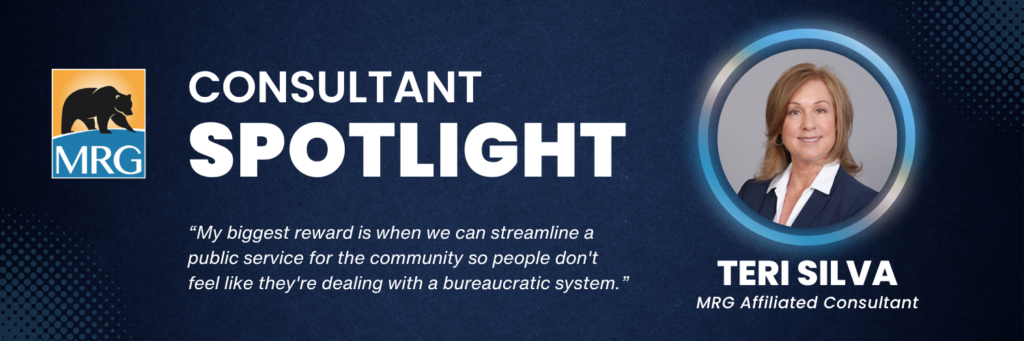
Teri Silva is an experienced professional in Human Resources and local governance. Her career spans over 38 years in public service, including as the Assistant City Manager and Human Resources Director for the City of Sunnyvale. Teri holds a Bachelor’s Degree in Human Relations from Golden Gate University and a Master of Science in Human Resources Management from Chapman University.
What should your clients know about you from the start?
I really like to just roll up my sleeves and get into the work. I get a lot of satisfaction from meeting project goals and deadlines and I enjoy the sense of accomplishment brought by crossing items off my to-do list.
Of course, over the years, I’ve become more of a strategic thinker when implementing larger projects, looking not only at the implementation strategy but also at the impacts on those affected by the project and I’d consider that my greatest superpower.
I faced tough situations in my career that necessitated navigating complex personnel rules, the civil service rules or working through the meet-and-confer process with labor groups. It’s a challenge, but I don’t back away from a challenge just because it’s difficult. Preparation and good communication are key: You have to get ready for the hard work and get it done by setting up the meetings and talking it through with the impacted parties.
Do you have a motto, or is there a word or phrase that people associate with you?
I have ground rules when I hire new managers or when I’m new to an organization. One of these rules is no surprises. If there’s something going on in my organization and I should know about it, I like to have a heads-up and I commit to communicating to others who need to be in the know as well.
A big thing for human resources is credibility. So another ground rule I have is: If you don’t know the answer, don’t guess. Let the person know you need to research it and that you’ll get back to them – and then make good on that commitment by getting back to them.
My other ground rule is to be responsive to your customers, both internal and external. In human resources, our external customers are typically our applicants. Our internal customers are our employees in the organization, and we have to provide effective customer service to both groups.
What other career paths have called to you?
That’s an interesting question because I really didn’t pick human resources, I kind of fell into it when I started working. I worked for a school district for about 15 years before I went to a city and I then went on to get my formal education to support that field. I later became an assistant city manager but when I look back, I really hadn’t planned a career path heading in that direction either.
If I took a different path, I probably would do something like renovating houses because it’s project-based. You start with a house that needs work, you fix it up, and then you sell it. Again, it has the starting and ending point that I get great satisfaction out of.
What inspires you about working in the public sector?
In the public sector, everything is so challenging because you’re guided by several sets of rules. Sometimes you’re guided by legislation, the Education Code, civil service rules, or municipal code. My biggest reward is when we can streamline a public service for the community so people don’t feel like they’re dealing with a bureaucratic system. There’s nothing more frustrating for your community than feeling like they can’t get an answer, they’re jumping through hoops, and nothing is getting accomplished.
At the City of Sunnyvale, we had the resources to put good processes and good customer-service expectations in place for staff. Part of my role as assistant city manager was reviewing the responses we sent to residents, community members, or businesses that submitted concerns through our communication system. I’ve been really fortunate to be in these great work environments where I’ve been able to provide that type of leadership or skill set.
What made you want to affiliate with MRG?
I’ve known Mary Egan since the early 2000s. When I started in city work, Mary was one of the first outside individuals we brought in to do investigations for us. She has always been so straightforward, thoughtful, and honest with her feedback – she was just great to work with. I couldn’t think of a better opportunity than to consult with Mary at the head of the organization.
It’s a transition to move from a leadership role and then become a consultant. You have to change your philosophy because you’re giving people recommendations, and they can take them or not take them. It’s their choice, and you have to be in the mindset that it’s okay if they don’t want to take your recommendation.
MRG been really good for me because I’ve been able to take on different projects and have a variety of opportunities that have been a good use of my work experience and knowledge. MRG also has great resources to assist consultants as they work with their clients. In addition, consultants have a lot of flexibility in assignments and work hours. For me, it has been a nice balance that has resulted in a good pace so far.
Does your public sector organization need support in overcoming organizational challenges? Reach out to MRG at info@solutions-mrg.com to connect with expert solutions.